
Guide for Delve in Path of Exile

Introduction
The Delve League arrived with Patch 3.4, and introduced an alternative to the conventional end-game experience. Since then, Delving has become a core mechanic in Path of Exile. Due to its incredible potential for experience gain, profit, singular crafting mechanics, and entertainment, it is essential that all exiles have a firm understanding of the fundamental systems in play.
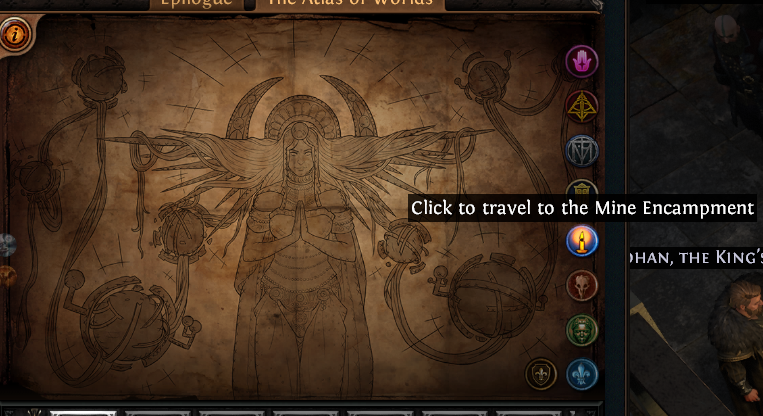
All Delving begins in the Azurite Mine, which only be accessed after encountering Niko in Act IV. To [re]enter the mine, simply interact with any Waypoint and click on the icon in the bottom right corner, marked with a “Candle” icon.
Delving is an infinite and randomly generated dungeon system that exiles can explore, shared between all characters on any given league. Players can move throughout the Azurite Mine by going laterally or downwards. Subsequent levels of depth increase the monster level, up to a maximum of level 83, and add additional damage, health, and affixes to the monsters once end-game levels are achieved. The rewards also increase with depth, although this is hard-capped at 1500 depth.
Voltaxic Sulphite is necessary to power the Mine Cart, which allows the player to explore the mine’s depths. Sulphite can only be acquired by completing missions for Niko. Exiles can travel to connected points on their subterranean chart, though each Delve costs a fixed amount of sulphite, which is based on the depth and the distance traveled.
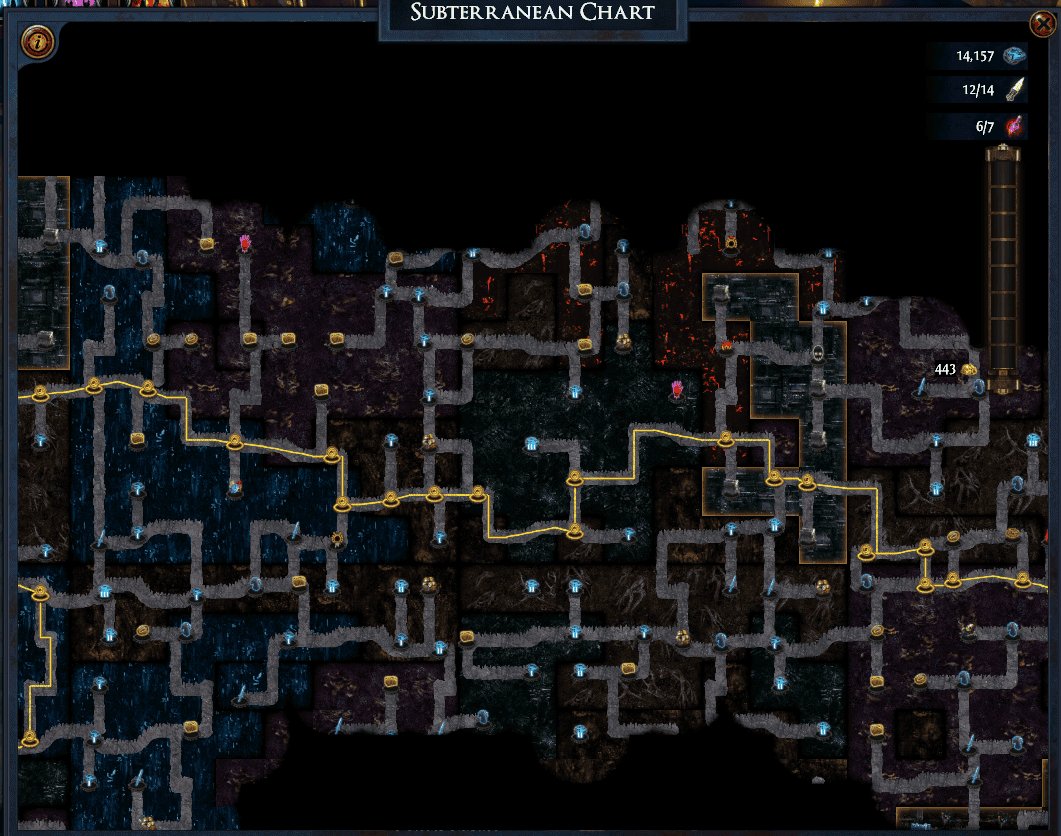
The Mine crawler will speed up to match the movement of the player if they are moving faster than the cart, but its speed it capped by your current Movement Speed stat. If you venture into the Darkness, the Crawler will slow or stop, depending on how far you are from it.
The Darkness of the Mine
The Mine is in a state of perpetual darkness, which can only be penetrated by following the Mine Cart during a Delve, or by dropping a temporary Flare on the ground (default key “6”). Flares can be crafted at the Voltaxic Generator.
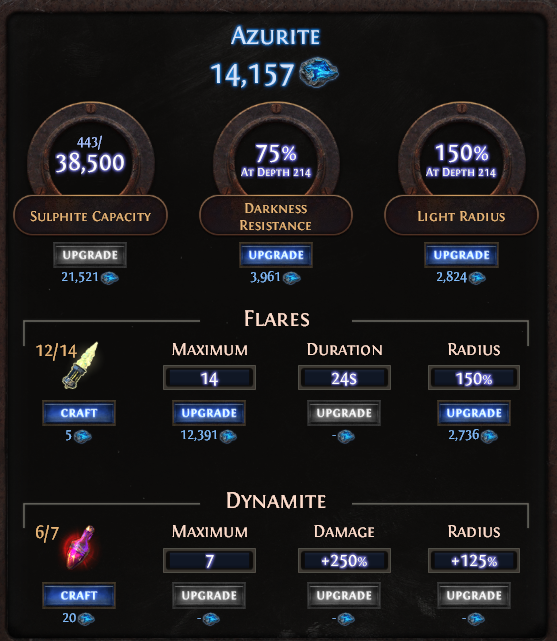
Standing in the Darkness will cause the player to take 2% of their Life and Energy shield per second, per stack (at 0% Darkness Resistance). This effect stacks every 0.25 seconds and is cleared the instant you re-enter a lit area. Light Radius and Darkness Resistance decrease automatically the deeper the player Delves, but can be increased again using the upgrades the mine offers.
Monsters that are shrouded cannot be damaged by the player, so beware if you are attempting to leech off of them. Over-leech, high regen, on-hit, and on-block defensive layers can help counteract the degen applied from Darkness stacks.
Upgrading Your Mine
There are a variety of upgrades that can be purchased to facilitate further and more frequent delving. All of them require Azurite, which is obtained via delving, and can be purchased from the Voltaxic Generator found in the mine.
The upgrades require progressively higher amounts of Azurite with each upgrade, which naturally necessitates deeper delving, where the rewards are more plentiful.
Which Upgrades Do I Make First?
When beginning a league for the first time, you may ask yourself how best to spend your early Azurite most efficiently. The answer is simple; in virtually every situation the best upgrade to purchase is Increased Sulphite Capacity.
We recommend upgrading Sulphite Capacity at least ten times or so before making any significant investments towards other upgrades. This will grant you a Sulphite Capacity of 22500, which is a comfortable buffer so that you can encounter Niko multiple times before capping out. The cumulative cost is roughly 7000 Azurite, so it should not take long to achieve.
Below we have provided a list that ranks our recommended priority for Mine upgrades. Since upgrades cost significantly more with each rank increase, you should still upgrade some of the lower-priority options, as the low ranks will only cost a few Sulphite.
- Sulphite Capacity (Until 22500)
- Light Radius ( Until 150%)*
- Flare Radius (Until 0%)
- Flare Maximum (~10)
- Flare Radius (Until 150%)
- Darkness Resistance (Until 0%)*
- Dynamite Maximum
- Dynamite Damage
- Flare Duration
- Dynamite Radius
- Darkness Resistance (Until 150%)*
- Flare Maximum
- Sulphite Capacity
The upgrades to Dynamite are great for bossing. When bossing the strategy for Dynamite is to drop wait 2 seconds and drop another. This can help to finish off the last phase much quicker as they do % damage. If you don’t plan on doing delve bosses, then skipping Dynamite Radius and Damage is advised.
*If you plan to delve deeper than 1000+, it may be worth skipping Darkness Resistance, Light Radius, and Flare Radius. These become very expensive to keep up with costing multiple divines worth of azurite. All 3 of these stats have a minimum of -200% for Darkness Resistance, and the minimum light radius is a very small radius around the cart and player.
Acquiring Sulphite
Once Niko is encountered in Act IV, each instance you enter has the chance to contain 1-3 caches of Voltaxic Sulphite. Sulphite gain is based on two factors, which are:
- The level of the area, or the effective level in Maps
- Quantity bonus (if any)
Sulphite Scarabs
- Sulphite Scarab: Area Contains Niko
- Sulphite Scarab of Fumes: Sulphite Found in Map Area Releases Enraging Fumes. Monsters Affected by Enraging have 50% increased Item Quantity. Sulphite in your maps is guarded by Monsters from the Azurite Mine
For the sake of delving, the normal Sulphite Scarab is the only one used, and only if you aren’t planning to allocate the passive points needed from the Atlas tree to hit 100%.
Niko Atlas Passives
There are 5 Atlas Passive wheels currently on the Atlas tree as of 3.28. Allocating all but 1 small node of “Your Maps have x% chance to contain Niko” nodes that are located as part of 4 of these wheels will give you 100% chance to for your maps to contain Niko.
Notable Atlas Passives:
- Frantic Mining: Gives your Maps a +20% chance to contain Niko. Also adds
- Sulphite Infusion: This node adds 400, 700, and 1000 extra sulphite gained on map completion of white, yellow, and red maps, respectively.
- Packed With Energy: When you interact with Voltaxic Sulphite Veins or Chest in your Map, Gain Sulhpite Intoxication. (Each stack of Sulhpite Intoxication grants 35% increased Damage, 15% increased Movement Speed and +1% to all maximum Elemental Resistances)
- Mining Byproducts: Voltaxic Sulphite Veins and Chests in your Maps have 15% chance to contain double Sulphite.
- Guarded Hoards: Voltaxic Sulphite Veins and Chests in your Maps are guarded by Sulphite-hoarding Monsters
- The Price of Progress: Voltaxic Sulphite Veins and Chests found in your maps contain Doomed Spirits. (Spawns a strongbox, tormented spirit or a small shrine.)
It is recommended to allocate all of these except “The Price of Progress” to increase the rate at which you acquire Sulphite from a map. You can also skip Guarded Hoards and Sulphite infusion if you don’t plan on killing anything in the maps while gathering your Sulphite.
Fractured Walls
Fractured Walls appear frequently in the Mine and can be destroyed with dynamite. While they are far more common than most players believe, they are generally found off the main path of the Crawler, well shrouded in darkness. This means that if you are not frequently venturing off the main path using Flares, you are not likely to encounter many Fractured Walls.
Fractured Walls often conceal valuable items and loot, and in particular, the “Resonators” and “Fossils” that are unique to delving. Certain fossil rewards can only be found behind Fractured Walls.
Once you have reached end-game levels of delving, it is generally worth exploring the areas adjacent to the crawler’s main path. Longer delves will often have 2-4 Fractured Walls along their entire path, which can supply the player with tens or hundreds of  Chaos Orbs worth of loot.
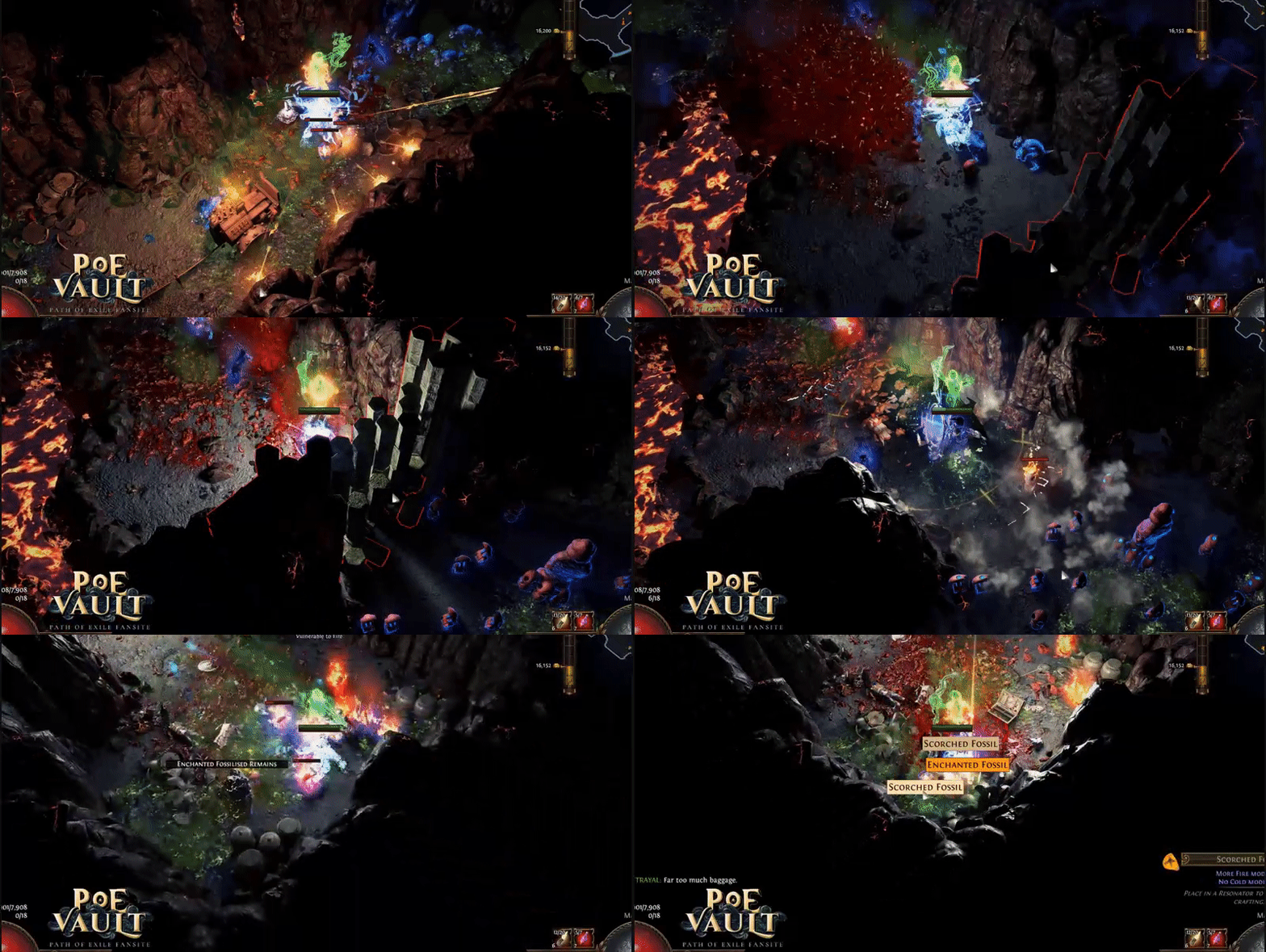
Be sure to drop a Flare while looting your caches.
Becoming Comfortable with Flares
Flares are arguably the most important tool you will leverage while Delving. Since Sulphite is a limited resource, getting the maximum experience and loot out of every Delve is highly recommended. Flares, on the other hand, can be crafted for only 5 Azurite each, and are practically unlimited, as you can return to craft more after each Delve.
You can more than double the amount of monsters and wealth you accrue by simply exploring the side rooms while Delving and dropping Flares to ensure you survive and can properly damage the mobs. Upgrading Flare Light Radius is significantly helpful for players who frequently employ Flares while Delving.
Flare Delving
It is possible to Delve without Sulphite using Flares alone. This is done by simply crafting as many Flares as you can carry, traveling to a previously completed node on the Subterranean Chart, then clearing nearby monsters and side areas. This can be great for profit early in the League with little investment.
Which Nodes Offer the Best Rewards?
This can depend heavily on a variety of factors, which are:
- Your choice of League (Softcore, Hardcore, or Solo Self-Found)
- Your current Depth
- RNG
For the most profit, you will want to hit the following nodes:
- The Crystal King’s Throne
- The Grand Architect’s Temple
- Minion & Aura Item Nodes
- Azurite Fissure
- Time-Lost Cavern (Glyphic Fossil)
- Molten Cavity (Faceted Fossil)
- Humid Fissure (Fracture Fossil)
- Crystal Spire (Hollow Fossil)
- Smuggler’s Stash (Assorted Fossils)
This Regex will highlight all the nodes above, excluding Fossil Smuggler’s Stash:
King|spire|Humid Fis|grand|time|Molt|minion|Azurite Fis
Just copy and paste into the Subterranean Chart search bar!
Cities
Cities are typically valuable biomes to locate, mainly due to their chest rewards and potential bosses. Cities are marked by an enclosed area on the Subterranean Chart; an example Vaal City is shown below.
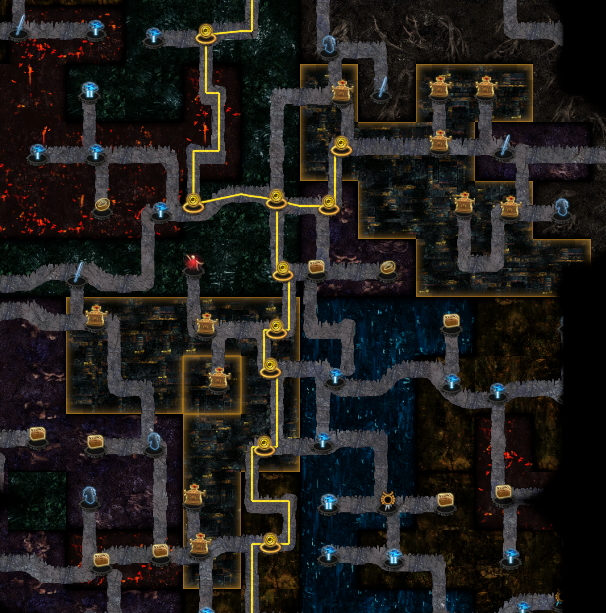
There are three types:
- Vaal Outpost (Starting at 32 Depth | Highest Chance at 200)
- Abyssal City (Starting at 70 Depth | Highest Chance at 350)
- Primeval Ruins (Starting at 110 Depth | Highest Chance at 500)
Despite the fact that the biomes have differing suffixes (Outpost, City, and Ruins, respectively), they are commonly referred to as Cities by players. Vaal and Abyssal Cities can be encountered relatively early in the Delve progression, as early as 32 and 70 respectively. Primeval Citites however, can only be found past Depth 110, and are less common. While the cities have different tilesets they all have the same basic layout, shown below. The chances to find Vaal Outpost, Abyssal City, and Primeval Ruins max out at 200, 350, and 500, respectively.
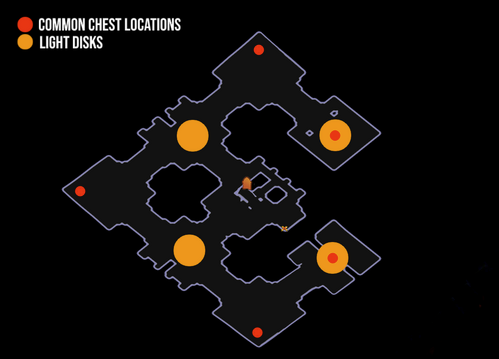
The “Light Disks” referred to in the image can produce temporary lights that illuminate the city. Standing on them counts as being “in the light”, and the player will not suffer damage from the Darkness. After several seconds of standing on the disk, it will “flare up” and illuminate the surrounding area and corridors. This effect will dissipate after around ten seconds, however, it can be reactivated or maintained by returning to the disk.
The above layout can also be vertically mirrored, but the basic premise is identical.
Delve Bosses
Delve Bosses can only spawn in the City biomes named above, and are even more Rare than the cities themselves. There are 3 Delve bosses, and each is related to the biome that they spawn within.
| City Type | Node Name | Boss | Earliest Depth Encountered |
|---|---|---|---|
| Vaal | The Grand Architect’s Temple | Ahuatotli, the Blind | 50 |
| Abyssal | The Lich’s Tomb | Kurgal, the Blackblooded | 90 |
| Primeval | The Crystal King’s Throne | Aul, the Crystal King | 130 |
Aul and Kurgal are typically considered the more challenging of the three bosses.
Delve Bosses scale with depth health and damage with depth, meaning that they become significantly more difficult when paired with additional affixes. Make sure to read the affixes by hovering the node associated with the boss.
Boss Rewards
The Delve Bosses drop a variety of Uniques that can only be obtained from them specifically.
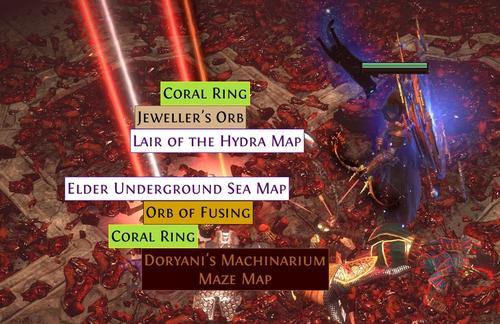
For example,  Doryani's Machinarium can only drop from Ahuatotli, the Blind, and has been valuable at certain points in the League.
While all bosses have unique rewards, Ahuatotli and Aul are generally considered the more valuable of the bosses. Skipping Kurgal is quite common.
| Boss | Reward | Drop Depth |
|---|---|---|
| Ahuatotli, the Blind | Doryani's Machinarium |
72 |
| Ahuatotli, the Blind | Curiosity (Bottom Part of  The Adorned) The Adorned) |
82 |
| Kurgal, the Blackblooded |  Uzaza's Mountain Uzaza's Mountain |
any |
| Aul, the Crystal King | ###item:auls-uprising-all-attributes### | any |
| Aul, the Crystal King |  Ahkeli's Mountain Ahkeli's Mountain |
any |
| Aul, the Crystal King |  Uzaza's Valley Uzaza's Valley |
any |
| Aul, the Crystal King |  Crown of the Tyrant Crown of the Tyrant |
any |
| Aul, the Crystal King |  Luminous Trove Luminous Trove |
68 |
| Aul, the Crystal King | Desecrated Virtue |
81 |
Aul Bloodline
The Aul Bloodline is a Bloodline many builds use for access to “Precursor’s Release”, which is generally used for the line that states “Action Speed cannot be modified to Below Base Value if you have Equipped Boots with no Socketed Gems.” While this is a very popular choice, many players never step foot into delve, making for a niche market.
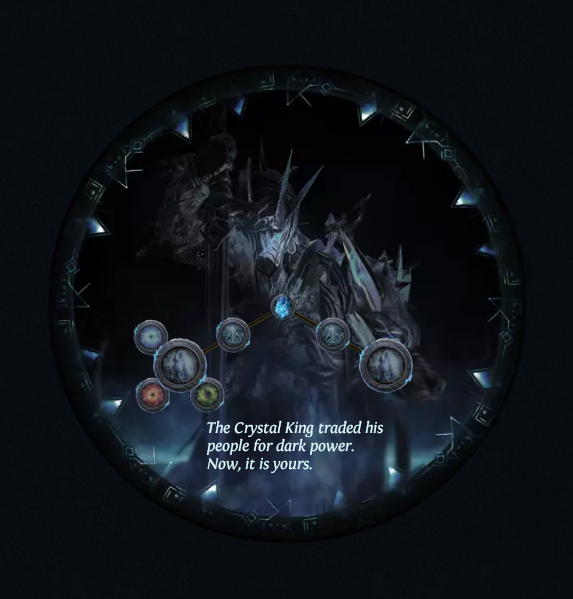
To make a profit this way from a delve, you can offer taxi/carry services for Aul, the Crystal King. Many players use Trade 820 for carry services and you can offer to sell access to the Bloodline or use Global 820 if you wish to share it for free.
Hidden Paths: How to Unlock Them and When are They Worth it?
You will often encounter points on the Subterranean Chart that cannot be immediately accessed by the crawler.
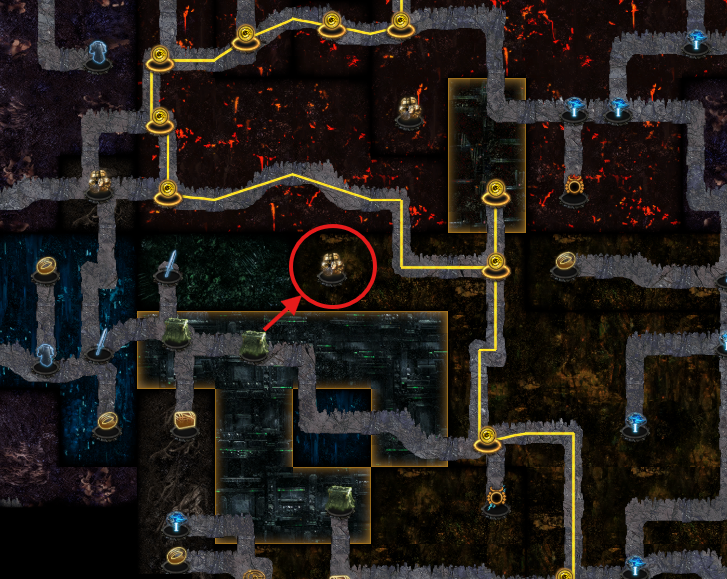
Unlocking Hidden Paths
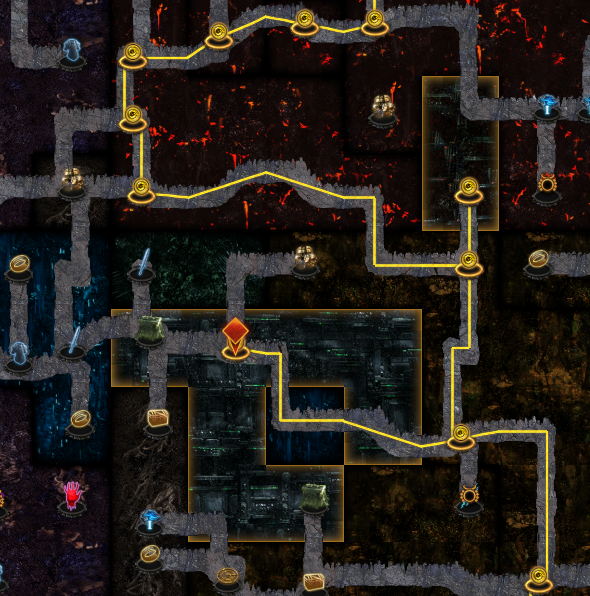
These nodes can be accessed by blowing up a specific fractured wall. Once the wall is destroyed, the node will then appear as a possible connection on the Subterranean Chart, allowing the Crawler to access it like a normal Delve.
In many cases, this is pretty easy. Like all paths on the Subterranean Chart, the Hidden Path must connect to another node. Consequently, you should always start exploring from the nodes that surround the disconnected node, searching for the correct wall to destroy. Something to keep an eye out for is the “1-3-4 rule” each node in delve can have 1, 3 or 4 paths coming off it. If a node has 2 path, there is a hidden path coming off this node, also nodes that have a single path will never have a hidden path coming off of it.
When Is It Worth It
Only search for hidden paths if the node at the end is one you would normally path to for its reward. Hidden paths should be treated like any other node don’t go out of your way unless the destination is worth the investment.
This means you will skip some nodes you would normally path to, such as Azurite Tier 3, but you should always check for hidden paths leading to high-value rewards, including Boss, Minion, Fossil, and other desirable nodes.
Low Level Delving for Profit and Fossils
Since the majority of fossils and resonators are found behind fractured walls, delving into lower depths purely for the goal of profit is actually a viable strategy. Since the sulphite costs per delve are so low relative to the sulphite a mapping-level player can generate, one can delve for hours or days without the need to refuel. With only a few small upgrades to Darkness Resistance, your exile will also take negligible damage from the darkness.
This allows you to employ one of a few strategies:
- Simply run through the darkness, using flares to reset your Darkness or leech from monsters if necessary. No sulphite is required.
- Return to a Delve you have already cleared and follow the lit cable, searching for hidden walls. You can “reset” the passage by going to a new node and then returning.
- Delve as normal and simply run ahead of the cart, exploring the side caves.
Our goal is to locate as many Fractured Walls as possible. Fractured walls are typically far more common in longer Delves, as there are far more side areas and opportunities for them to spawn. Extremely short delves are unlikely to have more than a single Fractured Wall, and often none at all. There are several Pros and Cons to this method.
Pros
+ No currency investment
+ No gear or damage required, as the monsters will be such a low level
+ Reliable and consistent profit
+ Easily sustainable
+ Great for Hardcore and Solo Self-Found leagues due to the low risk and high amount of Fossil and Resonator returns
Cons
– Low profit per hour compared to the mid and high tier farming strategies
– No experience gain
– Extremely tedious
What Depth Should I Stop At?
Since Delving is technically an infinite system, this question can only be answered by your build. Many builds will struggle to continue past Depth 300+ without dying occasionally, due to the severity of the scaling. If experience is your main priority, it is best to stop between Depths 270-300. This allows you to easily farm level 83 monsters and encounter all possible biomes and bosses, but remain relatively safe. Simply proceed horizontally across the Subterranean Chart, but do not be afraid to deviate up or down as necessary to chase the most desirable biomes and rewards.
The best depth to fight bosses if your build can handle it is around 500. This is where many people stop to farm profit, as this is the highest chance to farm Aul.
The absolute maximum rewards from delve end at 1500. Where fossil and azurite rewards cap out. This takes a very good build and is not for the faint of heart.
Deep Delve
Why do it?
Deep Delve for context of this guide ranges from 600 and beyond.
Many people want to do Deep Delve for many reasons. The main reason many seek out Deep Delve is profit, the scaling of fossil and azurite rewards scales all the way until 1500 depth. This is where many build stop to farm the most efficient money delve can offer. Others push as far as their build will let them, testing the relative strength of their build and the very dedicated delvers push all the way to 6000 depth, the actual max of the “infinite delve”.
So why do it? Only you can answer that, but many people have found Delve to be a fun and profitable test to see how far they can push a build. How deep will you Delve?
Notes for Deep Delve Players
If you plan on pushing pass 1000-1200 depth it is suggested to get use to having negative Darkness Resistance and no cart or flare Light Radius. Darkness Resistance follows the rule of -200% is the maximum its can negatively scale, meaning that -200% and -2000% are the same. While light radius has a inherit minimum. The Azurite requirement exponentially scales to upgrade your cart and is impossible to keep up with at around 1300 depth.
Another note is that the health and damage of mobs exponentially scale from about 600-1500, and then linearly pass that until 6000. Rare mobs will generally hit HP cap at around 3500 depth and tanky blues around 6000 depth. This makes rares and blue mobs harder than many of the bosses found in delve, requiring extremely optimized delve builds to take down.
Nodes you should try to avoid at extreme are Beyond, Time-Lost and Molten Cavity as they can be extremely hard to clear even for the best builds.
Conclusion
Delving can offer substantial rewards, challenges, and experience. The style of play is also extremely different from mapping, and many players find it relaxing or “autopilot”, as you simply have to follow the crawler and kill everything in your path. We recommend always raising your mine depth to the maximum monster level (Level 83 at Depth 270) as early as possible after you have reached mapping levels. Even if you are not entirely supplementing your end-game with Delving, you will certainly want the option to leverage the Mine for its rewards when possible.